Types of Scars Treated with Hair Transplant
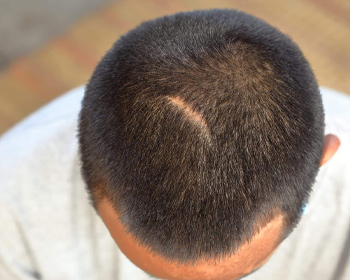
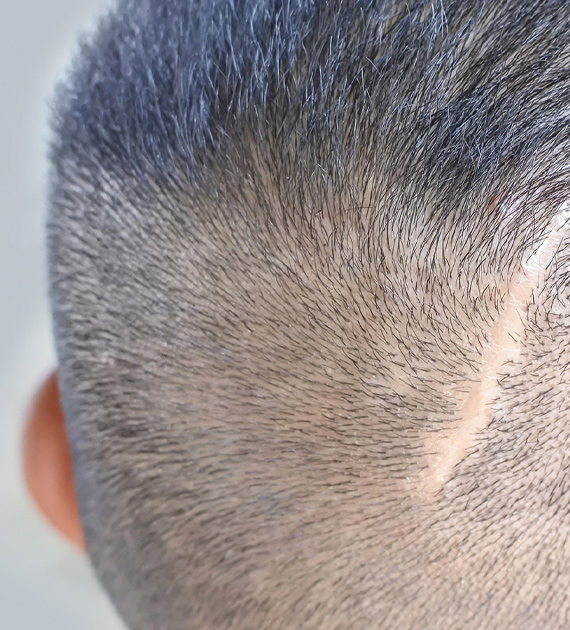
1. Linear Scars from FUT Hair Transplants
Often caused by strip surgery, these scars are found at the back of the scalp and can be concealed with grafts.
2. Burn Scars
Thermal, chemical, or electrical burns may leave bald patches that are treatable through transplant.
3. Surgical or Traumatic Scars
Accidents or surgeries on the scalp or face often leave scars where no hair grows.
4. Cleft Lip or Facial Reconstruction Scars
Facial scars affecting the moustache or beard area can be effectively camouflaged.
5. Eyebrow Scars
Scars from injuries or prior eyebrow tattoos can be covered with eyebrow hair restoration.
Who is a Good Candidate?
-
You have a visible scar with no hair growth
-
You are healthy and free from uncontrolled medical conditions
-
You have adequate donor hair on your scalp or body
-
You have realistic expectations regarding the result
-
You desire cosmetic improvement and better symmetry
During your consultation, Dr Dushyanth Kalva will assess your scar’s condition, thickness, blood supply, and location to determine the likelihood of success.
Procedure – Step by Step
1. Consultation and Evaluation
A detailed assessment of the scar area is performed. The shape, size, texture, and depth of the scar are evaluated.
2. Donor Hair Extraction
Using the FUE technique, healthy hair follicles are taken from the donor site—typically the scalp, or sometimes the beard or chest for coarse hair.
3. Recipient Area Preparation
Micro slits are created in and around the scar to allow precise placement of grafts. Extra care is taken due to the different nature of scarred skin.
4. Graft Implantation
Follicles are implanted at the correct angle and density to mimic surrounding hair and create a natural transition.
5. Aftercare and Recovery
Post procedure instructions include scalp care, medications, and activity restrictions. Healing is usually quick and uneventful.
Recovery and Expected Results
After the transplant, the area may appear slightly red or swollen, which usually subsides in a few days. The transplanted hairs may fall out within the first few weeks—a normal part of the process. New hair growth begins within 3 to 4 months, with full results visible by 9 to 12 months.
Scar tissue may have slightly lower graft survival compared to normal skin, but with advanced technique and proper planning, results can be highly satisfactory.
Cost of Scar Revision Hair Transplant in Hyderabad
The cost of scar revision hair transplant in Hyderabad depends on several factors:
Size and location of the scar
Number of grafts required
Technique used
Quality of donor hair
Overall complexity of the case
At Inform Clinics, we provide a personalized quote during your consultation based on the scar’s characteristics and your hair restoration goals.
Real Stories. Real Results.
We have helped many individuals regain their confidence by restoring hair in areas previously thought untreatable. Whether it is a scar from a childhood injury or a past procedure, Dr Dushyanth Kalva’s expertise has brought natural-looking results to hundreds of patients.
You can view before and after images during your consultation to understand what is achievable for your specific scar.
Why Inform Clinics is the Right Choice for Scar Revision Hair Transplant
Expert in cosmetic and reconstructive procedures
High level of precision and safety using FUE
Natural results even in scarred and difficult areas
Comprehensive consultation and planning
Proven track record and high patient satisfaction
Located in Hyderabad with modern facilities
Book Your Consultation Today
If you have a visible scar on your scalp, beard, or facial region and wish to restore hair in that area, consult Dr Dushyanth Kalva at Inform Clinics in Hyderabad. Learn how a scar revision hair transplant can transform your appearance and confidence.
Visit: Inform Clinics, Hyderabad
Call Now: Schedule your appointment and start your journey toward natural hair restoration.
Dr. DUSHYANTH KALVA
M.B.B.S., M.S - General Surgery, M.CH
Dr. Dushyanth Kalva has over 15 years of experience in Cosmetic Surgery and Hair Transplants. Besides his medical knowledge, he also holds an artistic vision for his patients and is known for performing the best cosmetic surgery in Hyderabad.
As one of the top plastic surgeons in Hyderabad, Dr. Kalva believes that every person has a right to 'look and feel their best'. Every person has a self-image or self-portrait in their mind. When physical appearance does not match their ideal self-image, it can lead to stress, dissatisfaction, and decreased productivity. That’s where plastic & cosmetic surgery comes into play.
Scar Revision Hair Transplant at Inform Clinics
Scar revision hair transplant is a specialized procedure that helps conceal visible scars on the scalp, beard, or eyebrow region by implanting hair follicles into the scarred tissue. At Inform Clinics, Dr. Dushyanth Kalva uses advanced techniques to restore natural hair growth and improve cosmetic appearance in scarred areas.
A scar revision hair transplant involves implanting hair follicles into or around scar tissue to camouflage visible scars caused by injury, surgery, or previous hair transplant procedures. This helps restore a more natural and uniform look.
This procedure can treat scars from FUT (strip) hair transplants, accidents, burns, surgical incisions, or scalp infections. It’s suitable for linear, circular, or irregular scars where the surrounding skin can support hair growth.
Hair can grow on scar tissue if there is enough blood supply in the area. During consultation, Dr. Kalva evaluates the vascularity of the scar to determine if hair grafts can survive and grow in the treated region.
Yes, when done correctly, the transplanted hair blends seamlessly with surrounding hair. At Inform Clinics, we ensure the angle, direction, and density are matched to give a natural finish, minimizing the appearance of the scar.
Dr. Dushyanth Kalva brings years of expertise in handling complex scar cases with artistic precision. Inform Clinics uses advanced FUE tools to extract and implant grafts with minimal trauma, ensuring excellent graft survival and natural-looking scar coverage.